“I Passed My Compliance Audit; Now What?”

It’s that time again—time for your compliance audit. Depending on your business, it might be an annual audit from a government or regulatory entity, or it may be requested by someone with whom you’re about to do business—a prospective vendor, partner or client.

What’s involved in this audit? And if you pass, does that mean you’re good to go? What’s the next step?

What Is a Compliance Audit?

A compliance audit is a set of questions designed to make sure that you are complying with industry or federal regulations. Most often, these are related to security of information. The type of information varies, but the ultimate goal is the same: making sure that your organization is taking the appropriate steps to ensure the safety of the data that has been entrusted to you.

Audits across different industries ask different questions. A healthcare compliance audit will be looking for HIPAA metrics—steps taken to safeguard protected health information (PHI). Brokers are subject to FINRA compliance audits to ensure security in the financial industry, and organizations that contract with the government must comply with NIST requirements for cybersecurity.

Compliance audits average between 100-200 questions, most of which are highly technical and are best answered by your IT team or resource. It’s not a black-and-white pass/fail scenario, though. Since audits may vary not only by industry, but even from company to company, not every question will apply to your business. For example, a healthcare organization may send a HIPAA compliance audit to a potential vendor, but since the vendor doesn’t handle any PHI, many of the questions won’t apply. This doesn’t mean that the two can’t do business together; rather, it supports an informed discussion about their partnership.

If I Passed, That Means I’m Secure, Right?

Not exactly. As Anthony, one of our FIT engineers, explains, it’s just a first step. Compliance audits are concerned with different aspects of your business and environment, but not EVERY aspect. Some areas of your network are not included, but could still pose a vulnerability in your security.

Plus, most audit questions are not a simple pass/fail; you may have passed, but with the equivalent of a C. Think of your compliance audit as a report card—an assessment of where you’re at, and where you can improve. Once you identify those areas, what do you do about them?

Next Steps

Your compliance audit helps you develop a TBP, or Technology Business Plan, for what adjustments or improvements your IT environment needs over the next 3-24 months. Areas that barely passed or didn’t pass will be the primary areas of focus for your IT team, and can spur projects or other resolutions to help strengthen and streamline your network.

Since the main focus of compliance audits is security, take a good look at the cybersecurity measures you have in place. New threats emerge every day, so it takes a proactive approach and constant vigilance to counter attacks and defend against new vulnerabilities and exploits.

At FIT Solutions, we are your go-to IT resource. We complete compliance audits for you and make recommendations based on the results. We also help prepare your environment to meet and repel cyberattacks. Give us a call today at 888-339-5694 or contact info@fitsolutions.newdevsite.dev to see what elite IT service is like.


How to Become Unstoppable

In a world where the technology landscape is constantly changing, how do you stay ahead of the curve? You’ve got to change with it.

From a business perspective, this means continuing to learn and adapt, taking in new information and figuring out better ways to solve business problems.

At FIT, maintaining cutting-edge expertise is one of our seven core values—the guiding principles that shape our actions as a company. We’ll be delving into each of these values over the next several weeks:

  • Cutting-Edge Expertise
  • Humble & Adaptable
  • Elite Raving Fan Culture
  • Constructive Communication
  • Team Unity
  • Hard Work
  • Teach & Delegate

As an MSP, we serve as the IT support system for our clients. To do so while providing elite service requires a high level of technical excellence and knowledge. Our clients have widely varying IT environments, with different needs and toolsets, so we need to be broad and progressive in building our knowledge base. The more we learn, the more we can accomplish for our clients.

So how can maintaining cutting-edge expertise make you unstoppable?

Forming an Unstoppable Team

During the hiring process, we have a rigorous standard for experience, and place a high value on being an expert or highly capable technician. Some of this comes with on-the-job training, and some of it is a base requirement to join the FIT team.

To find the right mix, we look for particular qualities in job applicants as well as quantifiable data, like certifications. We want people who are humble and eager to learn, because teachability coupled with experience is an unstoppable force.

How Do We Maintain This Momentum?

The typical ramp-up for any company’s new hire is a heavily front-loaded training schedule, which tapers off as they get comfortable with their role and responsibilities. How do we keep an intense focus on maintaining and increasing expertise while balancing the needs of the day-to-day work?

We put a strong emphasis on continuous learning, with semiweekly engineer roundtables and monthly training sessions. In the pre-COVID-19 era, we hosted lunch-and-learns every month or two, inviting partners or engineers to present on particular topics. We leverage our partnerships with vendors to get training and updates on their tools until we know it as well as or better than they do.

We also make extensive use of LinkedIn Learning; our engagement falls in the 75th percentile of companies that use this platform. Our Learning paths are a combination of management-chosen and self-driven, and feature both the videos already offered by the platform as well as how-to and educational videos put together by our own team. It’s no surprise that computer networking and network administration are among our top skills learned, but the most popular programs actually center on communication, emotional intelligence and teamwork!

Our client base covers a range of industries, from healthcare to finance to manufacturing to recreation, and each industry comes with its own language of sorts. To be a true partner and actively contribute towards achieving their business goals, we need to be able to speak the lingo.  So some of our trainings are industry-specific, helping our engineers communicate effectively with our end-users and client contacts.

How Cutting-Edge Expertise Benefits You

Every single minute there are new things to learn. To stop is to stagnate. If you don’t prioritize learning and growth, you’ve basically stopped.

We see so many companies that are using obsolete systems because they ‘get the job done,’ without fully grasping how much time or revenue is wasted on inefficiencies. At FIT, we’re always working to learn what’s new and how to better solve business problems. We love getting to put that drive to work for you—searching out inefficiencies, implementing new solutions, and streamlining your environment until it hums.

Ready to work with a team of cutting-edge experts? Give us a call today at 888-339-5694.

Welcome to Idea Fest 2020!

We recently held our third annual Idea Fest, where employees develop and present ideas on how we can improve. These can revolve around how to improve your job, the whole company, or the service that we provide to clients. No idea is too small. We have two prizes: a $25 gift card for the best idea, and another $25 gift card for the best presentation.

Ideas are presented Shark Tank-style, where each presenter has the floor for 5-10 minutes, followed by a short Q&A session with other team members. The management team meets later to discuss the best ideas, decide the winners, and organize implementation of the winning ideas.

Idea Fest focuses on not just identifying problems or areas for improvement, but actually proposing solutions. Presentations are expected to include a plan for execution and the anticipated results.

This year, we had six presentations. David Gadson, our Procurement Manager, won Best Presentation for his idea for adding an Ultimate Team rating. Douglas Stanley, one of our remote engineers, won Best Idea for his proposed buddy system for improving new employee onboardings.

The FIT Ultimate Team

Accountability is really important to us: accountability to our customers, to our company, but also to each other as peers and teammates. David’s idea is a peer-to-peer rating system that focuses on how we are doing on our core values.

For example, one of our core values is Constructive Communication. So how are we doing? Do our team members have a hard time getting a hold of us to answer questions? Or are we quick to respond to questions? Is our speech negative or complaining? Or are we making an effort to be positive and upbuilding? Are we actively pursuing or working towards new certifications or improving our skills?

The idea was inspired by FIFA’s Ultimate Team rating system, created by EA Sports. Our version would be a similar system, ranking from 1 to 99 (no one is a zero, and no one is perfect), and would give you an honest, broad-reaching opinion on your work abilities and habits. It gives us something we can work on, and keeps us accountable, both to ourselves and to each other.

Ratings would be anonymous and would not be tied to salary, bonuses, or performance reviews. The Ultimate Team rankings are meant to help us keep creating and refining a Raving Fan culture.

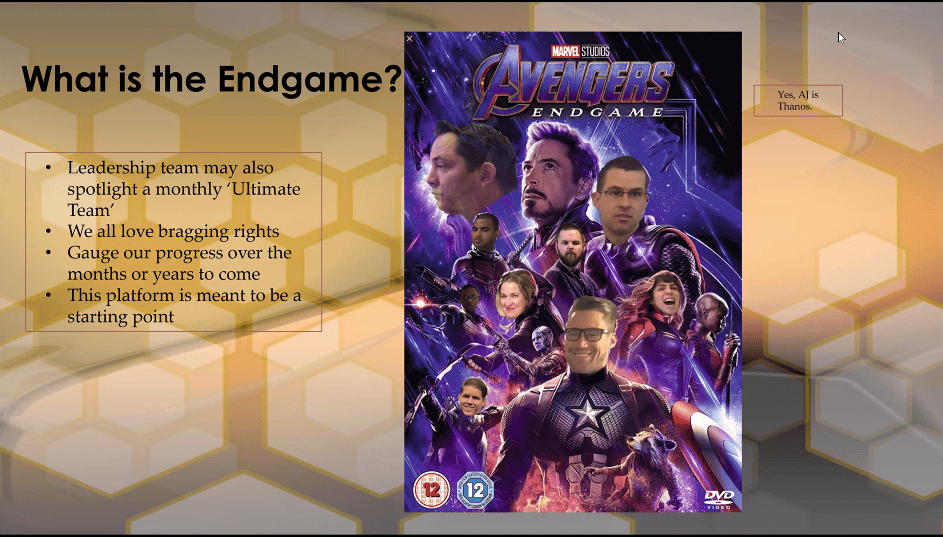
The concluding slide of David’s presentation (in which he photoshopped various team members into the Avengers) definitely played a part in his winning the Best Presentation award…

New Onboarding Buddy System

Since we serve clients all over the nation, a decent chunk of our team work remotely (even before the pandemic). However, starting a new job remotely presents some unique challenges. Douglas Stanley started his presentation by asking our remote engineers tied in for an honest rating of their onboarding experience, from 1-10. Suffice it to say, the average was not where we need it to be. We have some work to do!

There’s a certain degree of “out of sight, out of mind” for remote teammates that you don’t see in the office every day, especially in a company with 50+ employees. For those new hires, it can take even longer for them to truly feel like part of our FIT family. They don’t know who to go to with questions, and their new team is busy taking care of clients.

Douglas’ idea was a buddy system that assigns new hires to a single point of contact for the first 30 days. This mentor will walk them through our tools and procedures, have multiple daily check-ins, and be their go-to person for questions. They’ll also be available during the new hire’s first on-call shift.

The entire team loved this idea! Creating Raving Fans is one of our core values, and we want to give our team members the same Raving Fan service that we give to our clients.

The Fest Continues

Our other presenters proposed a company intranet, assigning product champions to develop a repository of shareable expertise on our various tools, a managed print solutions program, and a way to improve client interactions. We are exploring ways to implement some of these soon as well!

Hope you enjoyed this year’s Idea Fest as much as we did!

If you’d like to work with a team that welcomes innovation and creativity, we’d love to talk to you. Reach out to us at info@fitsolutions.newdevsite.dev.

Measuring KPIs: Do Your Actions Align With Your Vision?

From the FIT Leadership Team

We always strive to be fair, both to our clients and to our employees, and to create the best environment in which to work. We also strongly believe in bringing what makes this team wonderful to more businesses without compromising on quality. To accomplish that, we need to grow—both in quantity and quality.

As some of our most senior employees will tell you, FIT Solutions has always been on a growth trajectory. From our ‘garage-operation’ days until now, we’ve consistently looked for ways to grow and improve. There is no point where you have nothing left to learn or improve, so as the leadership team, we try to set an example of taking in knowledge, seeking out counsel and coaching, and holding ourselves to a higher standard every day.

As part of that constant refinement process, over the last year we’ve put increased focus on strengthening the foundation of our organization: our vision, our mission, and our core values. These make us who we are as a company, shape our team, and define more clearly our passion for solving business problems for our clients. Having the entire team on the same page when it comes to where we’re headed and how we plan to get there has been of immeasurable value.

With growth, though, often comes growing pains. We do our best to take these as the positive indicators they are of movement in the right direction. One of our core values is to stay humble and adaptable. The humility is essential to recognize where we have room for improvement, and the adaptability is vital to survive and thrive in an ever-evolving technological landscape. Those qualities are what move us to seek out opportunities to better ourselves as leaders, as partners, and as problem-solvers.

Over the past few months, we’ve been examining how we track and achieve goals within our organization. Exercising that core value of humility helped us to identify the need for an adjustment.

As humans, what we believe in and what we care about don’t always align with our behavior. For example, we may be interested in being healthy, and we may believe strongly that being fit or exercising regularly is important for good health—but are we acting in harmony with that belief? Do we take regular, methodical action to improve our diet or exercise routine? This is not always the case.

Similarly, the things we believe in at FIT—growth, adapting, creating the best environment—are not always evidenced by our actions. To be clear, we’re not talking about our team! We love our people and are very proud of everything they do. Rather, what we’re discussing here is a commitment by us, as the leadership team, to align our actions more closely with our vision.

Successful sports teams are often spoke of as being “tight”: operating like clockwork, moving efficiently and effectively, not wasting time or energy on actions that don’t align with the ultimate goal of winning. A team gets “tight” when its coach sets clear expectations and motivates his players to meet and exceed these goals. Why are the best athletes drawn to such a coach? Because through that guidance, players are able to achieve far more than they thought possible. A great coach helps athletes refine their skills and makes a workable environment for improvement and success.

Setting clear expectations and goals for our team members dignifies each individual and allows for constructive conversation. We encourage each employee to make a habit of regularly writing down their goals—personal, professional, and financial—and discussing these with their team lead in 1×1 meetings to see how FIT can help them reach those goals.

In line with this, we are introducing new KPIs, or key performance indicators, for each department and team. We already have some KPIs in place, but they are not always closely aligned with our vision and with the specific goals of each department. Returning to our sports example, the entire team may follow a common workout regimen. But if the quarterback’s goal is to get more touchdowns, and we know that running sprints gives him an edge on the field, then having him run sprints is in harmony with that goal. At first it may feel uncomfortable or difficult, but with practice, it becomes habit, improving his on-field performance.

At the end of the day, our ultimate goal is to do right by the people that depend on us—our clients and partners, our employees and their families, and our clients’ employees and families. In everything we do, we keep in mind the responsibility that we have towards this multitude of people.

If you are looking for an elite IT partner that is committed to catapulting your business to success, give us a call today at 888-339-5694.

“I’ve Got an IT Team; Why Do I Need a Managed Service Provider?”

We hear this from organizations pretty often; they have an internal IT resource, so they find it hard to justify partnering with a managed service provider, or MSP. Often, this is because people think that an MSP is designed to replace their IT department. However, an MSP can also be used as an extension of your internal team to support their work.

Why Does Your IT Team Need Support?

In short, it’s often impossible for small IT teams to have every specialization required by today’s ever-evolving technological landscape. Even the best engineers can’t be experts in everything; there’s just too much information out there.

This means that new projects and initiatives often require extensive research, trial and training before they can be completed. But your team’s day-to-day is already filled with end-user requests, operational maintenance, outage resolution and everything else they do to keep your business running smoothly. Keeping up with your business’ immediate needs is a full-time job, which forces your internal IT team to be primarily reactive, rather than proactive.

How an MSP Can Help

A managed service provider becomes an extension of your existing team, supporting them in these critical areas:

  • Filling knowledge gaps: We have 25 engineers, supporting a user base of about 7,500 across different industries and verticals. With this exposure, we’ve gained expertise on about a hundred IT enterprise toolsets and processes, making us a valuable and extensive knowledge base for your team.
  • Automating operational tasks: Automation of tools and processes covers a wide range of business operations, from managing desktops and alerts to installing upgrades and applying patches.
  • Increasing efficiency: By automating, documenting and streamlining your environment, we help IT departments increase their efficiency by 40%.
  • Access to enterprise-level toolsets: Enterprise-level toolsets for documentation, network monitoring, ticketing, and patching are usually prohibitively expensive for a small-to-medium-sized business. As an MSP, we’re able to leverage economies of scale to help businesses not just afford these toolsets, but also get the most out of them.
  • Project Support: Since your IT team is busy with the day-to-day tasks, there is little time to research and accomplish different projects for your organization. By automating tasks and providing expert support, we make everything else easier so your team can focus on those projects.
  • Proactive Technology Business Planning: We look for ways to apply technology to improve your operations, reduce costs, and boost efficiency. Every quarter, we put together a customized Technology Business Plan, which looks at your current environment and where improvements can be made while keeping within your budget. In fact, many of the recommendations don’t cost anything.

If you’re ready to take your department to the next level by partnering with a managed service provider, call FIT Solutions today at 888-339-5694 or email us here.

5 Reasons to Reexamine Your Connectivity Plan

When someone begins an IT services contract with us, our first step is to gather information about their current business and IT environment. Often, this discovery phase uncovers a disconnect in their communications situation. Here are five common pain points we see:

Pain Points

  1. Network Performance: The efficiency of your organization depends to a large extent on the efficiency of its network and applications. If your applications are running slowly or freezing up, this can irritate and slow down your workforce.
  2. Scaled Growth: Whether it’s meeting the user maximum on a VoIP plan, needing more physical phonelines for your in-office staff, or creating dedicated lines for clients, are you struggling to make your connectivity plan work for the current reality of your organization? The plan that worked for you when the contract was signed three years ago may not support the bandwidth needs of the user base you have now.
  3. Overpaying: We often find that better plans have become available but the provider is not notifying the client, so you’re paying more than necessary for their services. On top of that, when your contract with a provider expires, most of the time they jack up your rate to motivate you to sign another deal.
  4. Downtime: What does one hour of downtime cost your business? If you have a team of 20, and we figure your average hourly cost for this team is $1,000, one hour of downtime is roughly ten times more expensive than paying for a redundant cable connection. A company may be struggling with frequent downtime without understanding that it’s directly tied to an outdated or insufficient connectivity solution. At healthcare facilities, for example, admissions, medication orders, medical records, guest Wi-Fi—all of it depends on your Internet and phone lines. If they go down, this can directly affect your revenue and your compliance status.
  5. Mobility: Do you have a mobile workforce and find your communication solutions lacking in field applications or support? Especially in the wake of the pandemic, many organizations are moving to a work-from-home arrangement, and are scrambling to keep their team communicating, both internally and with customers.

How We Can Help

If your organization is struggling in one of these areas, we have a five-step process to help.

  1. Discovery: We start by collecting information. What is and is not working well? What system(s) are you currently using? Why are you looking for a change?
  2. Research: This is a big part of the value of our partnership. We navigate the telecom landscape for you, conducting extensive research on what options or alternate providers are available in your area. Who provides physical service to your building? What plan sizes are offered? We compile all of this into a spreadsheet to help you compare your options.
  3. Review: We go over the pros and cons of each option, set up webinars or demos with providers, request a proposal from chosen providers, and review those with you as well. We then negotiate with the provider to make sure we have the best promotions and are getting you the best services at the best possible price.
  4. Implementation: We will manage the implementation process all the way to the final sign-off. From billing to design to installation to training your team on the new system, we are your partner and advocate in dealing with the provider.
  5. Post-sale support: We don’t stop once you’re up and running; if you have any technical support needs, we work with the provider on your behalf and hold them accountable for a timely fix.

With an optimized connectivity solution, you’ll see these benefits:

  • Better application performance: Increased bandwidth can eliminate packet loss, latency & jitter.
  • Minimized downtime: Building true redundancy into the network by setting up primary & secondary connections cuts down on costs and compliance issues.
  • Expense management: By negotiating a better rate or finding a better plan for you, we help you redirect your budget dollars toward other organizational goals.
  • Expert assistance: We know the industry and the system; put our expertise to work for you to get you the best bang for your buck.

FIT Solutions and our partners work to provide elite IT services to organizations. Give us a call today at 888-339-5694 or contact us here to see how we can improve your business environment.

Why Firewall and Antivirus Aren’t Enough to Secure Your Business

“I have a firewall and antivirus, so I’m secure, right?” We hear this question from companies all the time. The answer is, that’s a great start, but you’re not quite done. Why not? To find out, let’s take a closer look at these two security measures.

What Does a Firewall Do?

A firewall is a program on your network that acts as gatekeeper, monitoring the inbound and outbound traffic. If you think of your business like a bank, the firewall would be like the security guard stationed at the entrance that prevents unwanted intruders from entering. That sounds like a pretty good system, until you consider a few drawbacks of firewalls.

  1. Firewalls operate based on predetermined rules. If someone figures out what those rules are, it’s not that hard to outsmart the firewall. In our bank example, your security guard may be instructed to turn away anyone in a red hat. Knowing this, the intruder wears a blue hat instead and is allowed to enter.
  2. A firewall is a reactive, problem-by-problem solution. It reacts to the immediate threat; it doesn’t look ahead to see the next approaching threat. The effectiveness of your firewall depends on those preset rules to block attacks, so if you’re not proactively watching the latest cyberthreats (and installing regular updates), it can’t fully do its job. This can leave you vulnerable to viruses or other cyberthreats.
  3. Your firewall protects your office network. If your employees access work emails or files from their personal devices, they can take that data outside of your company network. This has become a bigger threat with the recent pandemic-driven increases in work-from-home arrangements. Pandemic aside, though, if your employees conduct work outside of the office, perhaps using hotel Wi-Fi on a business trip, your company data could now be exposed on an unsecured network—where your firewall can’t protect it.
  4. Firewalls can’t stop user error. Criminals have a whole gamut of tricks for penetrating your system. Social engineering and phishing attacks in particular can completely sidestep your external defenses by targeting internal users. If one of your users unknowingly clicks a malicious link, your entire network could be shut down.

Does this mean you shouldn’t use a firewall? Absolutely you should; having a security guard with limited power is better than having none at all. We just want to make it clear why businesses shouldn’t entrust the safety of their data solely to their firewall.

What About Antivirus?

Antivirus is software that can prevent, detect, and remove malware. In our banking example, this would be like another security guard that makes regular rounds inside the bank, looking for suspicious activity. There are different kinds of antivirus software:

  1. Malware signature antivirus: This type scans for the digital fingerprint of a malicious program, known as a signature. The antivirus software comes preloaded with thousands of signatures, allowing the software to quickly identify and dispose of a threat that matches one from its database.
  2. System monitoring antivirus: This software identifies malware by looking for suspicious or unusual behavior—for example, if a user tries to access an unfamiliar website, or starts using significantly more data than usual.
  3. Machine-learning antivirus: Machine-learning pools data from multiple antivirus programs to recognize threats that it hasn’t seen before—an advantage over signature-based antivirus.

Given these abilities, why does antivirus not cover all the bases?

  1. Signature-based antivirus can only protect you against the threats that were programmed into it. It has no defenses against new threats or zero-day exploits.
  2. There are plenty of free antivirus software programs out there, and, while better than nothing, their database of malware signatures to check against is usually quite small. This drastically reduces the amount of threats it can protect you against.
  3. Antivirus doesn’t protect users against phishing attacks. A 2020 report by Check Point Research found that 65% of US organizations suffered a successful phishing attack in 2019—that’s two out of every three businesses!
  4. Most users don’t have antivirus on their phones or tablets, potentially leaving their device—and your network—vulnerable to attack.
  5. Cybercriminals represent the dark side of human ingenuity. They’re creative, constantly looking for new ways to get around your antivirus and firewall defenses. Even machine-learning antivirus software relies on combinations of data points. If an attacker figures out what combination will alert your antivirus to his presence, all he has to do is change one data point to trick it into marking him as legitimate traffic.

What You Can Do

  1. Update your firewall and antivirus regularly. Software patches and updates serve to reduce your system’s vulnerability and increase your software’s ability to identify and repel attacks.
  2. Develop a multi-layer security program. To return to the bank illustration, which bank would you trust with your money? A bank with one aged security guard? Or one with a whole patrol of security guards, cameras, alarm systems, biometric locks, and a dedicated monitoring team? Every security measure you add—SIEM, traffic analyzer, log management, SOC services, etc.—makes your organization that much stronger and more secure.
  3. Provide regular awareness training for your employees. Modern phishing and social engineering attacks are very sophisticated, and can be hard to identify. Just like your firewall and antivirus need to be updated frequently to stay effective, so does your team. A structured training program, either monthly or quarterly, can help your team recognize and repel attacks on your network.
  4. Don’t ‘set it and forget it’. Overconfidence or the feeling that you’ve already taken steps to defend your network can lull you into a false sense of security. Criminals are constantly testing new attacks, which calls for constant vigilance on our part to keep our defenses up to date. A third-party firm can conduct a social engineering campaign or penetration test for your organization to identify areas for improvement in your network or team.

FIT Solutions provides IT services, including cybersecurity packages. If you need an IT environment that scales with you, give us a call today at 888-339-5694 or contact us here.

How IT Departments Can Automate to Increase Efficiency by 40%

Too many IT departments get bogged down in doing manual work that could be automated. The root cause? Given the workload, the IT team simply can’t get ahead of the game. The time is never there to put the required tools and processes in place, and to master the associated learning curve — which is often steep. So talented staff spends the majority of their time focusing on repetitive tasks and rote troubleshooting instead of driving the business forward.

See if any of these scenarios apply to your organization:

  • Has your company asked your IT department to do more with fewer resources?
  • Have you been forced to reduce IT headcount, but still need to perform the same work?
  • Would you like to do more with the same IT staff?

If the answer to any of the above questions is yes, then read on.

The Impact of Outsourcing IT Automation

At FIT Solutions, we have the tools, processes and resources — coupled with the experience to apply them — to automate, standardize and streamline the IT environment. The bottom line is this: IT departments can increase their efficiency by 40%.

That improvement comes from application of best-practices automation coupled with economies of scale. Consider this: FIT Solutions successfully supports approximately 7,500 client users with a staff of 25 engineers. That’s one IT person for 300 employees — a ratio that can’t be touched by even the largest organizations. This doesn’t negatively impact our level of service, however; over the last 90 days, our customer satisfaction after over 1,000 reviews averaged 98.6 out of 100!

Here are some of the tasks we take on for our clients:

  • Managing desktops, mobile devices, servers and network infrastructure using automated tools
  • Installing and maintaining automated systems for handling upgrades, managing patches and applying them
  • Implementing and configuring automated systems that alert on issues based on varying degrees of severity and criticality
  • Establishing systems for log analysis, visibility, reporting and remote access — all to speed performance analysis, fine-tuning and troubleshooting
  • Creating and standardizing documentation for addressing regulations and resolving issues

Not Just Tools — But Years of Experience Using Them

Our engineers have spent years working with a stack of best-in-class automation tools and have developed proven methods for applying them efficiently across a wide variety of IT environments. We’ve done that work so your IT staff can piggyback on that experience. Too often, IT organizations invest in similar tools, but don’t have the time to utilize them fully so the investment falls short of delivering what’s promised—or worse, becomes ‘shelfware’. We can create those efficiencies for you, and either train your staff to apply them or simply take the administrative burden off your IT department’s hands.

Does being 40% more efficient sound good to you? To learn more about how we can optimize your IT environment in a way that delivers measurable increases in efficiency, call us today at 888-339-5694 or contact us here.

Why “If It Ain’t Broke, Don’t Fix It” Doesn’t Work for IT

Let’s say you have network equipment that’s been in place for years and is working with minimal or no issues. Paying to maintain service and support on those items might seem like an unnecessary expense. Certainly that’s the way many businesses look at it when scrutinizing the IT budget and looking for items to cut. The logic to justify de-funding those contracts is pretty simple: “If it isn’t broke, why pay to fix it?” However, that is a risky position to take.

Late in 2019, a manufacturer of wireless access points announced that a number of security vulnerabilities — some with a “critical” rating — had been found in its products. They fixed the vulnerabilities in short order and distributed the fixes in the form of software upgrades to the affected products. Here’s the rub: businesses without active support contracts didn’t have access to the upgrades.

Why Service Contracts Are Vital for Critical Infrastructure

The access points in question are widely used in installations that call for reliable, widespread business-class wireless coverage. In other words, they’re an extremely critical element of the infrastructure for organizations that rely on Wi-Fi to run their business. With the prospect of a security vulnerability that would allow an intruder access and potentially bring the entire wireless network down, the seemingly minor risk of letting the service contracts lapse turned into a major risk overnight. All of a sudden, companies were faced with an unbudgeted expense. They either had to re-up the contracts for all of the controllers and access points, or else replace their entire wireless infrastructure.

The same scenario and risks apply to all manner of critical network infrastructure, including switches, routers, firewalls, VPNs and servers. Vulnerabilities are constantly being discovered and patched with updates. We often think of these devices as appliances or hardware, but the reality is, they have software inside that’s meant to be upgraded to improve performance, add features or address security problems. Those devices are at the heart of the network and hold the keys to keeping the business running.

Is the Gamble Worth It?

Many companies do take the risk of running without maintenance agreements on key pieces of network equipment. They have weighed the risks against the costs and reached the conclusion that the gamble is worth taking. While at FIT Solutions we don’t recommend this approach, we do respect that it is a business decision. We are more concerned with businesses that simply allow their service and support contracts to lapse as a cost-cutting measure, without fully understanding the risks and taking them into account.

At FIT Solutions, part of our service is knowing what the vendor policies are with regard to upgrades, support, and service agreements, and keeping track of whether your agreements are active. We use this information to help you understand the risks of running your critical network infrastructure without the benefit of a safety net. Want a true picture of these hidden risks? Give us a call at 888-339-5694 today.

Get in touch.

Fill out the form and our team will get
back to you as soon as we can!